 Newspatrolling.com News cum Content Syndication Portal Online
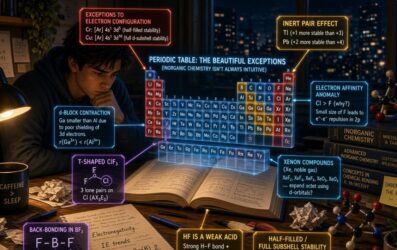
Inorganic chemistry exceptions essentially refer to cases where general rules do not hold true in specific conditions
There are many topics in JEE main exam that can be complex, difficult or confusing to understand. A relevant example is inorganic chemistry exceptions, which tends to confuse many students. There are various factors why general rules of inorganic chemistry may stop applying like they normally do.
That is because real molecules can be impacted by various factors. For example, molecules can be influenced by electronic effects such as induction, resonance and hyperconjugation. Other reasons include steric factors, mechanism changes such as radical vs. ionic pathways and solvent effects. There can also be reasons that a specific rule does not fully capture.
Importance of inorganic chemistry exceptions
These are important from a scientific perspective since they highlight the deeper principles at work. It is likely that these exceptions will prompt a scientist or researcher to dig deeper to gain a better understanding or even achieve a new discovery. It is known that chemistry works largely via inductive reasoning derived from observations.
If anomalies are present, they reveal incomplete models. This in turn creates opportunities for new synthetic possibilities. That’s why students preparing for JEE main exam need to understand these inorganic chemistry exceptions instead of just memorizing them. With proper understanding of these exceptions, students have a better chance of answering the questions correctly. This is especially true for trick questions or complex questions that are especially designed to confuse the candidate.
Why students get confused?
It is natural for students preparing for JEE main exam to get confused about questions on inorganic chemistry exceptions. Chemistry is already quite challenging with its various mechanisms, 3D structures and functional-group behavior. Moreover, these apply to a near infinite types of molecules.
Since rules are guides, exceptions essentially come across as something that is breaking the basic rule. These seemingly arbitrary exceptions are thus quite confusing. If students just focus on memorizing, they may not be able to answer complex questions based on these exceptions. That is why it is important to understand the ‘why’ of these inorganic chemistry exceptions.
Sample quiz on inorganic chemistry exceptions to revise for JEE main exam
Given below are some sample quiz questions on inorganic chemistry exceptions. These are divided into Basic, Medium and Complex questions. Answers are provided at the end of each set with explanation.
Part 1: Basic Level (20 Questions)
Questions
1). Question: Which element in Group 17 (Halogens) has the highest negative electron gain enthalpy (ΔegH)?
(A) F
(B) Cl
(C) Br
(D) I
2). Question: Which of the following elements has an anomalous electronic configuration with a completely filled d-subshell (3d10 4s1)?
(A) Cr
(B) Cu
(C) Fe
(D) Mn
3). Question: Which element in Period 2 has a higher first ionization enthalpy (IE1) than Oxygen due to a stable half-filled p-subshell?
(A) Nitrogen (N)
(B) Carbon (C)
(C) Fluorine (F)
(D) Beryllium (Be)
4). Question: Why does Beryllium (Be) have a higher first ionization energy than Boron (B)?
(A) Be has a higher nuclear charge than B
(B) Be has a fully filled 2s orbital with higher penetration power
(C) Boron has a larger atomic radius
(D) Boron has higher shielding effect
5). Question: Which neutral homonuclear diatomic molecule exhibits paramagnetic behavior despite having an even number of total electrons (12 electrons)?
(A) C2
(B) N2
(C) O2
(D) B2
6). Question: Alkali metals normally impart characteristic color to the flame. Which Alkaline Earth Metal cations do NOT impart any color to the Bunsen flame due to high excitation energy?
(A) Ca and Sr
(B) Mg and Ca
(C) Be and Mg
(D) Ba and Ra
7). Question: What is the basicity (number of ionizable H+ ions) of orthophosphorous acid (H3PO3)?
(A) 3
(B) 2
(C) 1
(D) 0
8). Question: Which of the following elements has the lowest melting point among Group 13 elements, such that it can melt on human palm top?
(A) B
(B) Al
(C) Ga
(D) In
9). Question: In the modern periodic table, atomic radii generally increase down a group. Why is the atomic radius of Gallium (Ga) smaller than that of Aluminium (Al)?
(A) Lanthanide contraction
(B) Poor shielding effect of 3d-electrons (Transition contraction)
(C) Inert pair effect
(D) High electronegativity of Ga
10). Question: Which halide of Beryllium forms a polymeric chain structure in the solid state but exists as a chloro-bridged dimer in the vapor phase?
(A) BeF2
(B) BeCl2
(C) BeBr2
(D) BeI2
11). Question: Which oxide of Nitrogen is neutral to litmus paper despite being a non-metal oxide?
(A) N2O5
(B) NO2
(C) N2O3
(D) NO
12). Question: Generally, bond dissociation enthalpy decreases down the halogen group. Which bond has lower bond dissociation enthalpy than Cl-Cl due to inter-electronic repulsions?
(A) F-F
(B) Br-Br
(C) I-I
(D) At-At
13). Question: What is the geometry and total number of lone pairs on the central atom in Xenon Difluoride (XeF2)?
(A) Bent, 2 lone pairs
(B) Linear, 3 lone pairs
(C) Trigonal planar, 1 lone pair
(D) Tetrahedral, 0 lone pairs
14). Question: Carbon monoxide (CO) acts as a strong ligand in complexes mainly because of:
(A) sigma-donation only
(B) pi-acceptance (pi-backbonding) capacity
(C) High polarity of C-O bond
(D) High basicity of Nitrogen
15). Question: Hydride of which Group 16 element has the lowest boiling point?
(A) H2O
(B) H2S
(C) H2Se
(D) H2Te
16). Question: Lithium shows a diagonal relationship with which element of the 3rd period?
(A) Na
(B) Mg
(C) Al
(D) Si
17). Question: Which species does NOT follow the octet rule because it is an odd-electron molecule?
(A) CO2
(B) NO2
(C) CH4
(D) SF6
18). Question: Which transition metal of the 3d series exhibits the maximum number of oxidation states?
(A) Fe
(B) Cr
(C) Mn
(D) Sc
19). Question: Hydrolysis of XeF6 yields which oxide of Xenon?
(A) XeO
(B) XeO2
(C) XeO3
(D) XeO4
20). Question: Why does PbCl4 act as a strong oxidizing agent while PbCl2 is stable?
(A) Resonance stabilization
(B) Inert pair effect
(C) High hydration enthalpy
(D) Diagonal relationship
Basic Level Answers & Explanations
- (B) Cl — Chlorine has higher negative electron gain enthalpy than Fluorine due to Fluorine’s extremely small size leading to strong inter-electronic repulsions in the compact 2p subshell.
- (B) Cu — Copper configuration is [Ar] 3d10 4s1 due to extra stability of fully-filled d-orbitals.
- (A) Nitrogen (N) — N (2p3, half-filled) is more stable than O (2p4).
- (B) Be has a fully filled 2s orbital with higher penetration power — 2s electrons are closer to the nucleus and harder to remove than the single 2p electron of Boron.
- (D) B2 — B2 (10 electrons) and O2 (16 electrons) are paramagnetic by Molecular Orbital Theory.
- (C) Be and Mg — Small size and high ionization energy mean flame thermal energy cannot excite their valence electrons.
- (B) 2 — H3PO3 has two -OH bonds and one P-H bond (non-ionizable).
- (C) Ga — Gallium has an unusually low melting point (~302 K / 29.7 °C) due to its simple Ga2 molecular structure in solid state.
- (B) Poor shielding effect of 3d-electrons (Transition contraction) — 3d electrons shield the nucleus poorly, leading to higher effective nuclear charge (Zeff) on 4s electrons in Ga.
- (B) BeCl2 — Polymeric in solid phase, dimeric (Be2Cl4) in vapor phase, monomeric at high temperatures.
- (D) NO — NO and N2O are neutral oxides of nitrogen.
- (A) F-F — Strong electron-electron repulsions between non-bonding valence pairs on small fluorine atoms weaken the F-F bond.
- (B) Linear, 3 lone pairs — XeF2 has sp3d hybridization with 3 equatorial lone pairs and 2 axial fluorine atoms.
- (B) pi-acceptance (pi-backbonding) capacity — CO forms strong synergistic bonds (sigma-donor + pi-acceptor).
- (B) H2S — H2O has a higher boiling point due to strong intermolecular hydrogen bonding. From H2S to H2Te, BP increases with van der Waals forces, making H2S lowest.
- (B) Mg — Li and Mg share similar ionic radii and polarizability.
- (B) NO2 — Contains 17 valence electrons (odd-electron molecule).
- (C) Mn — Shows oxidation states from +2 to +7 (3d5 4s2).
- (C) XeO3 — Complete hydrolysis: XeF6 + 3H2O -> XeO3 + 6HF.
- (B) Inert pair effect — +2 oxidation state is more stable than +4 for heavy Group 14 elements like Lead (Pb).
Part 2: Medium Level (20 Questions)
Questions
1). Question: Which of the following molecules has a bond angle strictly less than 90 degrees due to Drago’s Rule or specific lone pair repulsions?
(A) NH3
(B) PH3
(C) H2O
(D) BF3
2). Question: Order of ionic radii for N3-, O2-, F-, Na+, Mg2+, Al3+ (Isoelectronic series) is:
(A) Al3+ > Mg2+ > Na+ > F- > O2- > N3-
(B) N3- > O2- > F- > Na+ > Mg2+ > Al3+
(C) N3- > F- > O2- > Na+ > Al3+ > Mg2+
(D) Na+ > Mg2+ > Al3+ > N3- > O2- > F-
3). Question: In inorganic qualitative analysis, why does Hg2+ precipitate as HgS in acidic medium (Group II), whereas Zn2+ precipitates as ZnS only in basic medium (Group IV)?
(A) Ksp of HgS is much lower than Ksp of ZnS
(B) Ksp of ZnS is much lower than Ksp of HgS
(C) Zn2+ forms soluble complex in acid
(D) Hg2+ undergoes reduction in basic medium
4). Question: Which oxoacid of Sulphur contains a direct S-S single bond?
(A) Caro’s acid (H2SO5)
(B) Marshall’s acid (H2S2O8)
(C) Dithionic acid (H2S2O6)
(D) Pyrosulphuric acid (H2S2O7)
5). Question: Why does anhydrous AlCl3 sublime on heating and conduct electricity in the aqueous state, but NOT in liquid/molten state?
(A) It is ionic in solid, covalent in liquid
(B) It exists as a covalent dimer (Al2Cl6) in molten state and dissociates into ions in water
(C) It contains metallic bonds in liquid state
(D) Hydrolysis prevents conduction in liquid state
6). Question: Among Group 15 hydrides (NH3, PH3, AsH3, SbH3, BiH3), which one has the strongest reducing character?
(A) NH3
(B) PH3
(C) SbH3
(D) BiH3
7). Question: What is the correct increasing order of second ionization enthalpy (IE2) for C, N, O, F?
(A) C < N < O < F
(B) C < O < N < F
(C) C < N < F < O
(D) O < F < N < C
8). Question: What happens when Borax (Na2B4O7 . 10H2O) is dissolved in water?
(A) It forms an acidic solution of H3BO3 only
(B) It forms an alkaline buffer solution containing B(OH)3 and [B(OH)4]-
(C) It precipitates insoluble Boron hydroxide
(D) It liberates B2H6 gas
9). Question: What is the hybridization of atomic orbitals of Iodine in IF7 and its geometry?
(A) sp3d2, Octahedral
(B) sp3d3, Pentagonal bipyramidal
(C) sp3d3, Capped octahedral
(D) sp3d, Trigonal bipyramidal
10). Question: Why is orthoboric acid (H3BO3) treated as a weak monobasic Lewis acid in aqueous solution rather than a protic Arrhenius acid?
(A) It releases one H+ ion directly from its -OH group
(B) It accepts OH- from H2O releasing a proton (H+) into solution
(C) It undergoes self-ionization to yield H+
(D) It acts as a dibasic acid at higher temperatures
11). Question: The stability of +1 oxidation state among Group 13 elements increases in the order:
(A) Tl < In < Ga < Al
(B) Al < Ga < In < Tl
(C) Ga < Al < In < Tl
(D) Tl < Al < Ga < In
12). Question: Select the species that is ISOSTRUCTURAL with XeF4:
(A) SF4
(B) [ICl4]-
(C) CF4
(D) [BF4]-
13). Question: Which transition metal complex displays intense color due to Charge Transfer (LMCT) rather than d-d transition?
(A) [Ti(H2O)6]3+
(B) [Cu(NH3)4]2+
(C) KMnO4
(D) [Fe(H2O)6]2+
14). Question: Liquid ammonia solutions of alkali metals are deep blue and conducting due to:
(A) Free metal cations
(B) Solvated/Ammoniated electrons
(C) Formation of metal amide (MNH2)
(D) Nitrogen gas evolution
15). Question: Which halogen forms ONLY ONE oxoacid (HOF)?
(A) F2
(B) Cl2
(C) Br2
(D) I2
16). Question: In Diborane (B2H6), how many 3-center-2-electron (3c-2e-) banana bonds are present?
(A) 2
(B) 4
(C) 6
(D) 0
17). Question: Why is Cu2+(aq) more stable than Cu+(aq) in aqueous solution, despite Cu+ having a completely filled 3d10 configuration?
(A) Cu+ has lower ionization enthalpy
(B) Hydration enthalpy of Cu2+ compensates for its high 2nd ionization enthalpy
(C) Cu+ forms insoluble complexes easily
(D) Lattice energy of Cu+ salts is higher
18). Question: Identify the correct order of bond angle among NH3, PH3, AsH3, SbH3:
(A) NH3 < PH3 < AsH3 < SbH3
(B) NH3 > PH3 > AsH3 > SbH3
(C) PH3 > NH3 > AsH3 > SbH3
(D) All have identical 109.5 degree angles
19). Question: Why does Silicon dioxide (SiO2) exist as a high-melting 3D network solid, whereas Carbon dioxide (CO2) is a gas at room temperature?
(A) Carbon cannot form single bonds
(B) Silicon cannot effectively form p-pi to p-pi multiple bonds with oxygen due to large 3p orbital size
(C) SiO2 contains ionic bonds
(D) Silicon is a metalloid
20). Question: Nitrogen gas (N2) is chemically inert at room temperature primarily because of:
(A) Small atomic radius
(B) High electronegativity
(C) High bond dissociation energy of the N≡N triple bond
(D) Absence of d-orbitals
Medium Level Answers & Explanations
- (B) PH3 — According to Drago’s rule, central atoms in Period 3 or below attached to elements of electronegativity <= 2.5 do not undergo hybridisation; pure p-orbitals participate in bonding, giving bond angles near 90 degrees (~93.5 degrees for PH3).
- (B) N3- > O2- > F- > Na+ > Mg2+ > Al3+ — For isoelectronic species, higher nuclear charge (Z) leads to smaller ionic radius.
- (A) Ksp of HgS is much lower than Ksp of ZnS — In acidic medium, [S2-] is suppressed by common ion effect (H+); only cations with extremely low Ksp (like HgS) precipitate.
- (C) Dithionic acid (H2S2O6) — Structure: HO-S(=O)2-S(=O)2-OH, featuring a direct S-S bond.
- (B) It exists as a covalent dimer (Al2Cl6) in molten state and dissociates into ions in water — Liquid state has non-conducting covalent dimers, whereas hydration energy breaks it into [Al(H2O)6]3+ and Cl- ions in water.
- (D) BiH3 — As element size increases down the group, E-H bond strength decreases, making BiH3 the strongest reducing agent.
- (C) C < N < F < O — O+ becomes 2p3 (stable half-filled configuration), requiring highest energy to remove 2nd electron.
- (B) It forms an alkaline buffer solution containing B(OH)3 and [B(OH)4]- — Hydrolysis yields Na2B4O7 + 7H2O -> 2H3BO3 + 2Na[B(OH)4].
- (B) sp3d3, Pentagonal bipyramidal — IF7 has 7 bond pairs and 0 lone pairs.
- (B) It accepts OH- from H2O releasing a proton (H+) into solution — B(OH)3 + 2H2O <-> [B(OH)4]- + H3O+.
- (B) Al < Ga < In < Tl — Due to the inert pair effect, lower oxidation state (+1) becomes increasingly stable down Group 13.
- (B) [ICl4]- — Both XeF4 and [ICl4]- have sp3d2 hybridization with 4 bond pairs and 2 lone pairs (Square planar geometry).
- (C) KMnO4 — Mn in MnO4- is in +7 state (d0), so color arises from Ligand to Metal Charge Transfer (LMCT).
- (B) Solvated/Ammoniated electrons — [e(NH3)y]- absorbs light in the IR region and imparts blue color.
- (A) F2 — Fluorine is highly electronegative and lacks vacant d-orbitals to exhibit higher positive oxidation states.
- (A) 2 — Diborane contains two 3-center-2-electron B-H-B bridge bonds and four standard 2c-2e- terminal B-H bonds.
- (B) Hydration enthalpy of Cu2+ compensates for its high 2nd ionization enthalpy — Hydration enthalpy of Cu2+ is extremely high (negative) due to small size and double charge.
- (B) NH3 > PH3 > AsH3 > SbH3 — As central atom electronegativity decreases down the group, bond pair-bond pair repulsion decreases, reducing bond angle.
- (B) Silicon cannot effectively form p-pi to p-pi multiple bonds with oxygen due to large 3p orbital size — Silicon forms single Si-O covalent bonds in a 3D giant network lattice.
- (C) High bond dissociation energy of the N≡N triple bond — Triple bond enthalpy (~945 kJ/mol) makes it inert under normal conditions.
Part 3: Complex / High-Yield Level (20 Questions)
Questions
1). Question: What are the actual magnetic moments (u_eff) and structures of [Fe(H2O)5NO]SO4 (brown ring complex) and Sodium Nitroprusside Na2[Fe(CN)5NO] respectively?
(A) Fe is +2 in both, both paramagnetic
(B) Fe is +1 (u = 3.87 BM) in brown ring; Fe is +2 (u = 0 BM) in nitroprusside
(C) Fe is +3 in brown ring; Fe is +3 in nitroprusside
(D) Fe is +0 in both
2). Question: What is the correct anomaly observed in the Electron Gain Enthalpy (ΔegH) of Group 16 elements?
(A) O > S > Se > Te
(B) S > Se > Te > Po > O
(C) S > O > Se > Te
(D) O > Se > S > Te
3). Question: Consider the compounds NF3 and NH3. The dipole moment of NH3 is significantly higher than that of NF3 (1.47 D vs 0.23 D) because:
(A) N-F bond is non-polar
(B) In NF3, orbital dipole of lone pair opposes the resultant bond dipole of three N-F bonds
(C) NH3 has planar geometry
(D) Nitrogen has higher electronegativity than Fluorine
4). Question: White phosphorus (P4) reacts with boiling NaOH solution in an inert atmosphere of CO2 to yield:
(A) H3PO4 + NaH
(B) PH3 + NaH2PO2
(C) P2O5 + Na3PO4
(D) PH3 + Na2HPO3
5). Question: What is the order of acidic strength of oxoacids of Chlorine: HClO, HClO2, HClO3, HClO4?
(A) HClO > HClO2 > HClO3 > HClO4
(B) HClO4 > HClO3 > HClO2 > HClO
(C) HClO3 > HClO4 > HClO2 > HClO
(D) All have equal acidic strength
6). Question: Hydrolysis of NCl3 yields NH3 and HOCl, whereas hydrolysis of PCl3 yields H3PO3 and HCl. Why does this discrepancy occur?
(A) PCl3 is ionic while NCl3 is covalent
(B) Water attacks Cl atom in NCl3 via empty d-orbitals on chlorine; water attacks P in PCl3 via empty d-orbitals on phosphorus
(C) Nitrogen is more electropositive than chlorine
(D) PCl3 does not undergo hydrolysis
7). Question: Which statement correctly explains why TlI3 is ionic containing [Tl]+ and [I3]- ions rather than Tl3+ and three I- ions?
(A) Tl3+ is a strong reducing agent
(B) Tl3+ oxidizes I- to I2 because Tl3+ is a powerful oxidizing agent due to the inert pair effect
(C) Iodine cannot expand its octet
(D) Tl+ is unstable in aqueous media
8). Question: In the solid state, Phosphorus Pentachloride (PCl5) exists as an ionic compound consisting of which cationic and anionic species?
(A) [PCl4]+ (Tetrahedral) and [PCl6]- (Octahedral)
(B) [PCl3]2+ and [PCl7]2-
(C) [PCl5]+ and [Cl]-
(D) It exists purely as molecular sp3d trigonal bipyramidal molecules in solid state
9). Question: In the reaction of XeF4 with SbF5, the product formed is:
(A) [XeF3]+ [SbF6]-
(B) [XeF5]- [SbF4]+
(C) Xe + SbF5 + F2
(D) [XeF2]2+ [SbF6]2(2-)
10). Question: Why does the bond dissociation energy of halogen diatomic molecules follow the anomalous order Cl2 > Br2 > F2 > I2?
(A) Fluorine has high electronegativity
(B) Large inter-electronic repulsion between lone pairs in compact 2p orbitals of F2 weakens its bond relative to Cl2 and Br2
(C) Iodine exhibits d-pi to p-pi bonding
(D) Cl2 has metallic character
11). Question: What is the oxidation state of Iron in Potassium Ferrate (K2FeO4)?
(A) +2
(B) +3
(C) +6
(D) +8
12). Question: The compound B3N3H6 (Inorganic Benzene / Borazine) reacts with HCl. What is the major product formed?
(A) B3N3H9Cl3 where Cl attaches to Boron
(B) B3N3H9Cl3 where Cl attaches to Nitrogen
(C) No reaction occurs as Borazine is aromatic and inert
(D) Complete cleavage to BCl3 and NH4Cl
13). Question: Why does Fluorine NOT form any hexavalent or higher compounds like SF6 (i.e. FS6 or F6 doesn’t exist as central atom)?
(A) Absence of vacant d-orbitals in valence shell of Fluorine
(B) Fluorine is a gas
(C) Low electron affinity
(D) High oxidation state stability
14). Question: Silicones are organosilicon polymers. What is the monomer unit required to produce a linear cross-linked silicone polymer network?
(A) R3SiCl
(B) R2SiCl2
(C) RSiCl3
(D) SiCl4
15). Question: Which oxide of Chlorine is paramagnetic in nature and acts as an explosive radical?
(A) Cl2O
(B) ClO2
(C) Cl2O6
(D) Cl2O7
16). Question: Among the following species, which one has a bond order of 2.5 and is paramagnetic?
(A) O2
(B) O2+
(C) O2(2-)
(D) N2
17). Question: Concentrated nitric acid (HNO3) renders which of the following metal pairs passive due to formation of an oxide protective film?
(A) Cu and Ag
(B) Fe and Al
(C) Zn and Mg
(D) Na and K
18). Question: Heating ammonium dichromate (NH4)2Cr2O7 produces which gas and green solid residue?
(A) O2 gas and CrO3
(B) N2 gas and Cr2O3
(C) NH3 gas and CrO2
(D) NO2 gas and Cr2O3
19). Question: Why does anhydrous HF act as a weak acid in water, but becomes a strong acid when mixed with liquid SbF5?
(A) SbF5 acts as a strong Lewis acid accepting F- to form [SbF6]-, releasing free H+ (superacid)
(B) SbF5 oxidizes HF
(C) HF undergoes dimerisation
(D) SbF5 donates protons
20). Question: Structure of Peroxodisulphuric acid (H2S2O8) contains how many oxidation states of Sulfur and how many peroxo oxygen atoms?
(A) +6 oxidation state on both S atoms, 2 peroxo oxygen atoms (-O-O- linkage)
(B) +7 oxidation state on both S atoms, 0 peroxo oxygen atoms
(C) +4 and +6 oxidation states, 1 peroxo oxygen
(D) +5 oxidation state on both S atoms, 4 peroxo oxygen atoms
Complex Level Answers & Explanations
- (B) Fe is +1 (u = 3.87 BM) in brown ring; Fe is +2 (u = 0 BM) in nitroprusside — In Brown Ring complex [Fe(H2O)5(NO+)]2+, Iron is in +1 state (3d7, 3 unpaired electrons, u = sqrt(15) ~ 3.87 BM). In Nitroprusside, NO+ ligand with strong field CN- leads to low-spin 3d6 Fe2+ (u = 0).
- (B) S > Se > Te > Po > O — Oxygen has abnormally low electron gain enthalpy in Group 16 due to extreme electron repulsions in its tiny 2p shell.
- (B) In NF3, orbital dipole of lone pair opposes the resultant bond dipole of three N-F bonds — In NH3, lone pair dipole and N-H bond dipoles are in the same direction, whereas in NF3 they oppose each other.
- (B) PH3 + NaH2PO2 — Disproportionation reaction: P4 + 3NaOH + 3H2O -> PH3 + 3NaH2PO2 (Sodium hypophosphite).
- (B) HClO4 > HClO3 > HClO2 > HClO — Increasing number of resonance-stabilizing oxygen atoms on conjugate base (ClO4- is most stable).
- (B) Water attacks Cl atom in NCl3 via empty d-orbitals on chlorine; water attacks P in PCl3 via empty d-orbitals on phosphorus — Nitrogen has no vacant d-orbitals, so H2O attacks the vacant 3d orbital of Chlorine in NCl3, forming HOCl and NH3.
- (B) Tl3+ oxidizes I- to I2 because Tl3+ is a powerful oxidizing agent due to the inert pair effect — Tl3+ + 3I- -> Tl+ + I3-.
- (A) [PCl4]+ (Tetrahedral) and [PCl6]- (Octahedral) — Solid PCl5 exists as [PCl4]+ [PCl6]-. (Note: PBr5 in solid state forms [PBr4]+ [Br]-).
- (A) [XeF3]+ [SbF6]- — Strong fluoride acceptors like SbF5 abstract F- from xenon fluorides: XeF4 + SbF5 -> [XeF3]+ [SbF6]-.
- (B) Large inter-electronic repulsion between lone pairs in compact 2p orbitals of F2 weakens its bond relative to Cl2 and Br2 — Correct BDE order: Cl2 > Br2 > F2 > I2.
- (C) +6 — K2FeO4 => 2(+1) + x + 4(-2) = 0 => x = +6. Iron exhibits rare +6 oxidation state in ferrate ion.
- (A) B3N3H9Cl3 where Cl attaches to Boron — Addition of HCl occurs across polar B(+)=N(-) bonds; Cl- attaches to electron-deficient Boron atoms.
- (A) Absence of vacant d-orbitals in valence shell of Fluorine — Fluorine belongs to Period 2 (2s2 2p5) and lacks d-orbitals to expand valence shell beyond octet.
- (C) RSiCl3 — RSiCl3 undergoes hydrolysis to RSi(OH)3 which polymerizes in 3 dimensions to form cross-linked silicones. (R2SiCl2 gives linear chain polymers).
- (B) ClO2 — Chlorine dioxide contains an odd number of valence electrons (19 electrons), making it paramagnetic and radical-like.
- (B) O2+ — O2+ has 15 electrons. Bond Order = (10 – 5)/2 = 2.5. Unpaired electron in antibonding orbital renders it paramagnetic.
- (B) Fe and Al — Concentrated HNO3 forms a passive, insoluble surface oxide coating on Fe, Al, Cr.
- (B) N2 gas and Cr2O3 — Thermal decomposition: (NH4)2Cr2O7 -> N2 + Cr2O3 (green) + 4H2O.
- (A) SbF5 acts as a strong Lewis acid accepting F- to form [SbF6]-, releasing free H+ (superacid) — HF + SbF5 -> H+ + [SbF6]-, known as Fluoroantimonic superacid system.
- (A) +6 oxidation state on both S atoms, 2 peroxo oxygen atoms (-O-O- linkage) — Formula: HO-S(=O)2-O-O-S(=O)2-OH. Sulfur cannot exceed group oxidation state +6.