 Newspatrolling.com News cum Content Syndication Portal Online
 Artificial intelligence has become one of the biggest talking points in the film and animation industry in the past few years, spanning from big Bollywood titles to TV projects like Detective Boomrah.
To some, the growing popularity of AI represents the future of filmmaking and animation. To others, there are concerns that AI may eventually take the place of human filmmakers entirely, swapping out highly skilled professionals like foley artists for AI-generated sound effects instead.
The reality is that the majority of filmmakers in India don’t want to see AI replacing filmmakers and animation studios. Instead, these tools are helping filmmakers and their teams to accelerate very specific parts of the filmmaking process like testing ideas more quickly and speeding up tedious processes. For independent creators especially, that’s opening up opportunities that simply weren’t realistic before.
Here are six ways filmmakers and animators are using AI to flip the script.
Creating Characters Before Production Even Begins
One of the most interesting developments in the industry is the ability to create characters using AI during the early stages of production. Traditionally, developing a character could involve countless sketches, concept drawings, mood boards, and revisions before everyone agreed on a final direction. But with AI, this entire process can be accelerated and done in a fraction of the time.
Using AI, filmmakers can create numerous concepts for their characters in a matter of minutes. This eliminates the need to spend days drawing and deciding on things like appearances, costumes, ages, expressions, and art styles before settling on a direction. Instead of spending days wondering whether a character should look one way or another, they can see several possibilities side by side almost instantly.
Humans still make the most important creative decisions at the end of the day, but AI allows them to visualise their characters and ideas much sooner.
Key takeaways:
- Focus groups can offer feedback on character ideas much sooner if several visual paths are developed rapidly.
- Quick iteration moves faster and typically fuels richer creative talks when teams can point to visuals rather than lean on lengthy descriptions.
Storyboarding At Lightning Speed
Every filmmaker knows that planning out a scene takes as much time as shooting it.
Before cameras start rolling, directors often create storyboards to map out all of the angles for the scene. It’s an incredibly useful process, but it’s also time-consuming, especially for smaller productions with limited budgets.
So naturally, any tool (in this case, AI) that allows filmmakers to describe a scene in plain language and generate rough storyboard frames that are in line with their vision is a total game changer. The results won’t necessarily be polished enough for a final production package, but they’re often more than good enough for planning meetings, client presentations, or internal discussions.
For independent filmmakers who have to meet tight deadlines, being able to turn an idea into something visual within minutes can save a huge amount of time. This higher capacity for output in turn, also empowers more Indian filmmakers to gain exposure on a global scale.
Key takeaways:
- If created early enough, storyboards can reveal costly shots before production starts allowing for more accurate budgeting.
- Visual planning like this can also enhance communication between directors, cinematographers, production designers and VFX teams.
Turning Simple Ideas Into Animatics
One of the biggest challenges in animation is figuring out if an idea is going to work before investing the time, resources, and effort to create it. That’s where animatics comes in as a handy solution. An animatic is essentially a rough version of a scene that combines storyboards, timing, movement, and audio to give creators a sense of how everything will flow.
The good thing is that AI forecasting can significantly speed up the entire process here as well. Animators can use AI programs to generate rough sequences, experiment with pacing, and test different approaches without committing to a full production pipeline.
These rough animations allow animators to identify any potential problems early. Maybe a scene drags on too long. Maybe a joke doesn’t land. Whatever the case, discovering these issues before investing hundreds of hours into animation can save both time and money.
Key takeaways:
- Animatics allow you to test pacing before spending huge amounts of time and money on actors, sets or animation.
- Rough animations can expose continuity problems early on that can be very expensive to correct later.
Enhancing Visual Effects On Smaller Budgets
Visual effects have traditionally been one of the most expensive parts of filmmaking. Large studios can afford to employ teams of artists to work on VFX for several months. Independent filmmakers often don’t have the same budgets, but AI is helping to fill that gap.
AI-assisted filmmaking tools can help with removing backgrounds, tracking objects, rotoscoping, cleaning up film footage, and other tasks that can be very labour-intensive for filmmakers. Many of these jobs still require human oversight, but they can often be completed far more quickly than before.
This allows independent filmmakers and production companies with small budgets to achieve the same visual polish that was once reserved for teams with Hollywood-sized budgets. That’s particularly valuable for indie filmmakers trying to maximise every dollar.
Key takeaways:
- AI is bridging the divide between indie productions and larger studios by automating labour-intensive visual effects work.
- Speeding up clean-up workflows also allows artists to spend less time on repetitive technical tasks and more time crafting creative effects.
AI-Assisted Video Editing
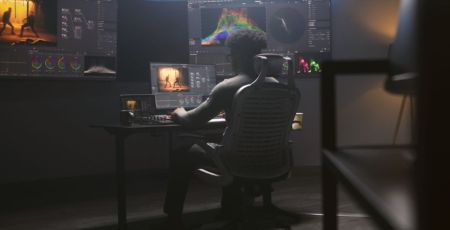
For most filmmakers, the edit is when the magic happens. It’s also where a lot of movies spend most of their production time. Hours upon hours of footage must be sorted, trimmed, synced, labelled, and watched before the fun part of editing can even begin.
AI is streamlining a lot of that background work. Now editing platforms can automatically transcribe interviews, identify which person is speaking, remove unnecessary pauses, sort clips into searchable bins, and even generate rough cuts with selected footage. Rather than digging through footage for that one perfect shot or syncing hours of audio, editors can dive into telling the story.
Don’t get it twisted, AI isn’t editing movies on its own. Cutters are still in charge of pacing, emotion, timing, and creative decisions. AI is simply eliminating the grunt work and giving filmmakers more time to perfect the moments that make us laugh, cry, and jump out of our seats.
Key takeaways:
- Searchable transcripts allow quick access to hours of footage to find specific lines of dialogue.
- Save time organising media and spend more time crafting pacing, emotional impact and storytelling.
Giving Filmmakers More Time To Focus On Storytelling
Perhaps the biggest benefit of AI isn’t any individual feature. It’s the time it gives back to filmmakers. Much of filmmaking involves repetitive jobs. Organising footage. Sorting out assets. Creating rough drafts. Testing film concepts. Cleaning up files. These jobs are absolutely necessary, but they’re rarely the reason someone got into filmmaking in the first place.
By automating some of these processes, filmmakers can spend more time on the parts of filmmaking that matter to the audience: story creation, character development, and pacing. So while the technology may be impressive, most viewers aren’t buying a ticket because a film used AI. They’re watching because they want a compelling story.
And any tool that filmmakers can use to spend more time on achieving that goal has the potential to be genuinely useful.
Key takeaways:
- The real edge for film studios won’t be in speed, but in the capacity for repeated story refinement prior to launch.
- By offloading repetitive production tasks to AI, creative discretion will be more important than ever.
Why Human Creativity Still Leads the Way
Despite all the discussion around AI in the film industry, filmmaking remains a deeply human craft. Great stories come from the human experience and AI simply can’t replace that.
What it can do is remove some of the friction that slows creative projects down. From character development to storyboards to visual effects, it’s increasingly becoming another tool in the filmmaker’s toolkit.
As with every other great innovation in the industry, the people who benefit the most will be the ones who learn how to use it effectively rather than fear it. And judging by how quickly the industry is experimenting, that process is already well underway.