 Newspatrolling.com News cum Content Syndication Portal Online

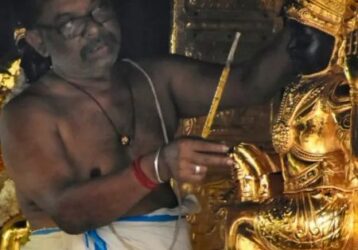 As lakhs of pilgrims gather at Sabarimala during the Makaravilakku season, awaiting the divine sight of the Makarajyothi, the revered Lord Ayyappa temple finds itself at the heart of a controversy that has deeply unsettled Kerala. Allegations of gold misappropriation have gone far beyond a routine criminal probe, opening up broader questions around faith, institutional safeguards, and political responsibility.
The issue originates from restoration work carried out on gold-plated copper structures at the temple, including the Dwarapalaka idols and parts of the Sreekovil. Former temple priest Unnikrishnan Potti, who oversaw the repair and maintenance, is accused of diverting gold during the process. Investigators allege that precious metal was removed under the guise of authorised restoration, a charge that has struck at the core of devotees’ trust.
The materials in question trace back to a major donation made in 1998 by industrialist Vijay Mallya. Around 32 kilograms of gold and nearly 1,900 kilograms of copper were donated for gold-plating the Sreekovil roof, thazhikakudams, and sacred steps. The project, valued at approximately ₹18 crore, was carried out under the supervision of the Travancore Devaswom Board.
In 2019, several decorative panels and sacred coverings were dismantled for restoration. Once the work was completed, the artefacts were returned and no objections were raised at the time. The matter resurfaced only in October 2025, following a vigilance inspection conducted by the Devaswom Board on the Kerala High Court’s directions. The inspection reportedly revealed discrepancies in the weight of certain gold-plated panels compared to earlier records.
Subsequent laboratory analysis indicated a reduction in gold content. Acting on these findings, the High Court ordered a detailed investigation and set up a Special Investigation Team (SIT), elevating the matter from an internal review to a full-fledged criminal probe.
Unnikrishnan Potti was named the prime accused. The SIT claims that gold-plated panels were removed from the temple and transported to a metal processing unit near Chennai on the pretext of repair work. Investigators allege that gold was chemically extracted from the alloy at the unit. The factory owner was arrested, followed by a Ballari-based jeweller accused of purchasing the extracted gold. The SIT is now examining whether altered or replica panels were subsequently returned to the temple.
As the probe widened, attention shifted from individual wrongdoing to failures in administrative oversight. Several senior Travancore Devaswom Board officials were arrested, including former administrative officer Murari Babu, former executive officer Sudheesh Kumar, and former commissioner for sacred ornaments K S Baiju. Their arrests reinforced suspicions that such alleged misappropriation could not have occurred without serious official lapses.
The case took a significant political turn on November 11 with the arrest of former Devaswom Board president N Vasu, a CPM leader. The SIT alleges that Vasu authorised the removal of a gold-plated sheet to Chennai for electroplating in 2019 and directed that it be recorded as copper in official documents. Investigators further claim he was aware that additional gold belonging to the temple remained with the accused after renovation but failed to ensure its recovery.
So far, two FIRs have been registered—one related to the alleged theft from the Dwarapalaka idols and another concerning irregularities in gold-plating of the temple door. Authorities have seized 576 grams of gold, including recoveries from a Ballari jeweller and from Potti’s Bengaluru residence. Officials believe this represents only a fraction of the gold allegedly siphoned off.
The arrest of senior Tantri Kandararu Rajeevaru added a particularly sensitive layer to the case. A member of the Thazhamon Madom family, which has led Sabarimala rituals for generations, he is the first serving Tantri to be arrested in connection with the controversy. In a remand report filed on January 9, 2026, the SIT accused him of criminal conspiracy and misuse of position, alleging that sacred coverings were dismantled without proper checks and prescribed rituals were bypassed. The Prevention of Corruption Act has been invoked, treating the Tantri as a public servant due to the honorarium he receives from the Devaswom Board.
With arrests spanning priests, officials, and political figures, the issue quickly turned political. Opposition parties accused the LDF government of administrative failure and demanded accountability from Devaswom Minister V N Vasavan.
The BJP intensified its criticism, arguing that responsibility for safeguarding temple assets rests with both the Devaswom Board and the state government. State BJP president Rajeev Chandrasekhar said accountability appeared to end with priests and mid-level officials, while political responsibility remained untouched. He announced that the party would observe Sabarimala Samrakshana Deepam on Makaravilakku Day to highlight concerns over transparency in temple administration.
Former BJP state president K Surendran also questioned what he described as selective action in the investigation. He pointed to the absence of arrests of former Devaswom Minister Kadakampally Surendran and senior official P S Prasanth, despite claims allegedly made by the prime accused. Surendran maintained that the Tantri’s role was limited to rituals, while control of the devaswom treasury lay entirely with the Board.
He further argued that the remand report focused more on alleged violations of custom than on establishing any clear financial gain by Rajeevaru. Surendran described Kadakampally Surendran as a key figure in the alleged conspiracy and questioned why former Board member K P Sankardas, who signed official minutes, had not been proceeded against.
Taking the allegations further, Surendran said Congress leaders had failed to explain a photograph showing Unnikrishnan Potti and Ballari-based jeweller Govardhan with Sonia Gandhi. He also referred to claims about links between Gandhi family members and firms dealing in antique idols abroad, alleging that senior Congress leaders had not offered clear responses despite earlier remarks on possible international angles.
BJP leaders insist they are not defending any individual but are demanding a comprehensive and impartial investigation that fixes responsibility across political, administrative, and institutional levels.
As the SIT continues its probe, the Sabarimala gold case has become a test of how Kerala addresses breaches of faith and public trust. For devotees, it raises unsettling questions about the protection of sacred assets. For the state, it remains a measure of whether accountability will extend beyond individuals to the systems entrusted with safeguarding one of India’s most revered temples.