 Newspatrolling.com News cum Content Syndication Portal Online
With Uniform Civil Code (UCC), the foundation can be laid for a more like-minded and mutually respecting society
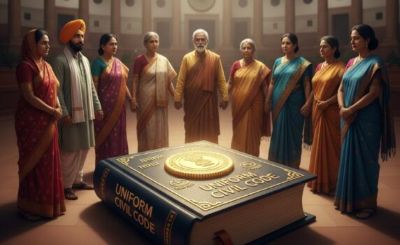
Uniform Civil Code (UCC) is a common set of laws that govern the civil aspects of the society. It includes things like marriage, divorce, adoption, succession, inheritance, etc. In the existing system, different rules for different communities create unnecessary problems and animosity. A Uniform Civil Code (UCC) will be applicable to all individuals, irrespective of their caste, gender, religion or community. UCC is also considered as a key factor in nation building. Let us check out more details to better understand Uniform Civil Code kya hai.
Existing civil laws
As of now, civil matters are governed by the respective religious beliefs and customs. For Hindus, Jains, Buddhists and Sikhs, the applicable laws include the Hindu Marriage Act (1955), Hindu Succession Act (1956), etc. For Muslims, the Muslim Personal Law (Shariat) Application Act (1937) is applicable. For Christians, the applicable laws include the Indian Christian Marriage Act (1872) and Indian Divorce Act (1869). In case of Parsis, the Parsi Marriage and Divorce Act (1936) is applicable.
Constitutional relevance of Uniform Civil Code
A UCC will work to replace all the personal laws with a single, secular code, which will be applicable to everyone. It will promote uniformity and contribute to promoting equality and secularism. Many people think that UCC is a new agenda. But that is not true. In fact, the Constitution itself has a provision for UCC, as mentioned in Article 44 of the Indian Constitution. This comes under Part IV (Directive Principles of State Policy).
Under this provision, it is stated that the state should implement a Uniform Civil Code across the territory of India. Top leaders like Dr. B.R. Ambedkar were in support of a Uniform Civil Code. Ambedkar had stated that UCC is necessary for national unity and gender equality. UCC does not interfere with fundamental rights, as many people believe. On the contrary, UCC works as a balance with Articles 25-28 (freedom of religion) and Article 14 (equality before law).
Historical background of UCC
During the British colonial era, matters were governed under uniform criminal laws, which came under the Indian Penal Code, 1860. However, as there was a possibility of hurting religious sentiments, the personal laws were left largely untouched. After India’s independence, Hindu laws were reformed via the Hindu Code Bills. However, similar reforms for other communities were not implemented, resulting in a major gap.
Judicial view of UCC
The judiciary has often come in support of UCC, as evident with their judgements in multiple cases. In the 1985 Shah Bano case, the Supreme Court highlighted the need to have UCC to ensure gender justice. In the 1995 Sarla Mudgal case, the court reiterated the need for UCC to prevent misuse of personal laws. In the 2003 John Vallamattom case, the court struck down the discriminatory Christian inheritance law and called for UCC to ensure equality. In the 2017 Shayara Bano case, the practice of Triple Talaq was termed as unconstitutional.
Current status of Uniform Civil Code
There is currently no Uniform Civil Code (UCC) at the national level. It only remains as a directive principle. However, one can see a trend of states bringing their own UCC laws. For example, Uttarakhand implemented its own Uniform Civil Code in January 2025. It became the first post-independence state in India to have a UCC. In Uttarakhand UCC, polygamy, halala and iddat are banned.
There is a uniform marriage age for all communities, 21 for men and 18 for women. All individuals have to follow the same inheritance laws and there is mandatory registration of marriages and live-in relationships. Similar laws are being worked out by other states and could be implemented in the future. It remains to be seen if a country-wide UCC is introduced, which will be a major milestone for the country. We hope this helped you understand – Uniform Civil Code kya hai.