 Newspatrolling.com News cum Content Syndication Portal Online
As Kerala approaches the 2026 Assembly elections, the political battle is shifting beyond coalition calculations or leadership shifts. Increasingly, it centers on the long-term direction of the state’s institutions.
For years, Kerala’s politics has been defined by a stable bipolar system, with the Congress-led United Democratic Front (UDF) and the Left Democratic Front (LDF) alternating power. This pattern ensured a degree of ideological clarity despite strong competition. That clarity, however, now appears to be under pressure.
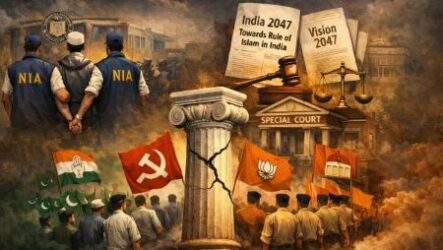
In 2022, the Union government banned the Popular Front of India (PFI) under the Unlawful Activities (Prevention) Act after coordinated raids by the National Investigation Agency (NIA). Kerala saw a significant number of arrests, highlighting the organisation’s presence in the state. The ban remains under review, and related cases continue in special courts.
Subsequent court proceedings referenced documents such as “Vision 2047,” which investigators claim outlined long-term ideological goals, including organised recruitment and influence-building within educational and civic spaces.
In June 2025, the NIA submitted an affidavit in a Kochi court mentioning another document titled “India 2047: Towards Rule of Islam in India.” The agency alleged that it described a phased strategy to reshape India’s constitutional framework by the centenary of independence. These claims remain part of ongoing legal proceedings and are yet to be judicially determined.
The reference to 2047—marking 100 years of independence—has been interpreted by investigators as suggesting planning that extends beyond electoral cycles. While courts will ultimately decide the validity of these claims, the issue has added a deeper institutional dimension to political debate.
In the 2021 Assembly elections, Congress won 21 seats, while the Indian Union Muslim League (IUML) secured 15. In parts of the Malabar region, IUML’s organisational strength continues to be crucial for the UDF.
Coalition dependence is common in democratic politics, but prolonged reliance can have structural implications. Over time, electoral coordination may lead to policy adjustments.
Recent elections have also witnessed mobilisation linked to the Social Democratic Party of India (SDPI) and networks associated with Jamaat-e-Islami Hind, signalling a shift from peripheral engagement to more routine political interaction.
While democracy thrives on diverse voter participation, the key concern is whether such accommodations gradually reshape policy boundaries. Institutional change rarely happens abruptly; it tends to unfold incrementally.
The LDF has traditionally projected itself as a secular alternative, though electoral realities have also required flexibility, sometimes blurring ideological lines.
Kerala’s political strength has long rested on constitutional values shaped by reformers like Narayana Guru and leaders such as E.M.S. Namboodiripad, fostering a culture rooted in rationalism and institutional reform.
Today, observers point less to sudden disruption and more to gradual change.
The Bharatiya Janata Party (BJP), which secured 12.4% of votes in 2021, made a symbolic breakthrough by winning its first Lok Sabha seat in Kerala in 2024. It frames its growth as a response to what it calls appeasement politics, advocating constitutional nationalism and uniform legal principles.
Critics, however, caution that sharper ideological divides can also strain institutions.
Ultimately, the debate is constitutional rather than religious. It revolves around how democracy responds to organised ideological efforts and how mainstream parties balance electoral strategy with institutional integrity.
The 2026 election will not just decide the next government—it will test whether political pragmatism reinforces or gradually reshapes Kerala’s constitutional framework.
Reference : https://www.oneindia.com/india/ideological-uncertainty-creates-space-in-kerala-s-2026-race-7995147.html