 Newspatrolling.com News cum Content Syndication Portal Online
 You finish a meal and feel like you swallowed a rock. The bloating starts. Maybe there’s a dull heaviness, a sluggishness that makes you want to lie down. You tell yourself it’s just a heavy meal. But when it happens most days — after different kinds of food, at different times — it stops being about what you ate. It starts being about how your body is digesting. And that difference matters more than most people realize.
What Your Digestive Discomfort Is Actually Telling You
Digestion is not just about breaking down food. It is a complex process that involves enzymes, gut bacteria, stomach acid, bile production, and a nervous system that regulates all of it. When one part of this system is underperforming, the rest compensates — until it can’t.
The bloating, the irregular bowel movements, the fatigue after meals — these are not random inconveniences. They are signals that something inside the digestive chain is off. Most people respond by taking an antacid or changing their breakfast. The symptom quiets down for a while. But the underlying cause stays untouched.
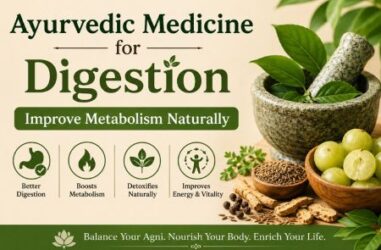
This is where the conversation around Ayurvedic medicine for digestion becomes genuinely relevant — not as an ancient remedy repackaged for trend value, but as a framework that has always asked the deeper question: why is digestion weak in the first place?
The Internal Mechanism: What Goes Wrong and Why
At the center of Ayurvedic digestive thinking is the concept of Agni — the body’s metabolic fire. Modern science aligns closely with this in principle. Your body’s ability to digest and absorb nutrients depends heavily on enzymatic activity, stomach acid levels, and the microbial environment in your gut.
When Agni is low — or in physiological terms, when digestive enzyme output is reduced and stomach acid is insufficient — food is not broken down properly. Partially digested food particles linger in the gut, ferment, and create gas. The gut lining gets irritated. Absorption of nutrients like iron, B12, magnesium, and zinc starts to decline. Over time, this creates a cascade of problems that show up far from the stomach.
- Low stomach acid slows protein breakdown, reducing amino acid availability
- Poor bile flow impairs fat digestion and fat-soluble vitamin absorption
- A disturbed gut microbiome increases intestinal permeability
- Chronic low-grade gut inflammation begins to affect systemic health
This is how weak digestion leads to fatigue. To brain fog. To dull skin and hair thinning. The gut is not isolated — it is connected to almost every system in the body.
Root Causes Most People Overlook
Digestive weakness rarely comes from one single habit. It tends to build gradually, shaped by several overlapping patterns:
- Eating at irregular times, disrupting the body’s digestive rhythm
- Chronic stress, which suppresses digestive secretions through the gut-brain axis
- Over-reliance on processed foods that lack fiber and enzymes
- Eating too fast, which reduces chewing and mechanical breakdown
- Frequent use of antacids, which further lowers stomach acid over time
- Sedentary lifestyle, which slows gut motility
These causes stack. And when they are present together for months or years, the digestive system doesn’t just have a bad day — it settles into a chronically weakened state.
How Ayurveda Approaches the Problem Differently
Ayurvedic herbs and formulations work not by suppressing symptoms but by supporting the body’s internal digestive function. Herbs like Trikatu, Triphala, Ajwain, and Ginger are not random remedies. Each one targets a specific part of the digestive process — stimulating enzyme production, improving bile secretion, reducing fermentation, or calming gut inflammation.
This is systems-level thinking. You are not stopping the bloating from being felt. You are addressing why the food isn’t being processed cleanly. Approaches like Mool focus on this kind of root-cause correction — identifying where the digestive system is underperforming and supporting it from within, rather than layering symptom management on top of an unresolved problem.
If you are exploring where to begin, a structured Digestion relief kit designed around restoring gut function can be a thoughtful starting point.
The Gut-Body Connection You Cannot Ignore
It is worth pausing on how far-reaching poor digestion actually is. The gut produces a significant portion of the body’s serotonin. It houses the enteric nervous system, sometimes called the second brain. It trains the immune system.
When digestion is chronically compromised:
- Skin conditions like acne or dullness often trace back to gut inflammation and toxin buildup
- Hair loss may link to poor absorption of zinc, iron, and protein
- Low energy often connects to impaired B12 and iron uptake in the small intestine
- Mood instability can reflect gut-brain signaling disruption
These are not coincidences. They are the body showing you how interconnected its systems are.
Final Thoughts
Improving digestion naturally is not about taking the right herb at the right time and waiting for results. It is about understanding what your digestive system needs to function well — the right foods at the right times, stress that is managed rather than suppressed, and internal support that works with your body’s own processes rather than around them.
The body is not broken. In most cases, it is managing the best it can under conditions that were never ideal for it. When you start correcting those conditions — gradually, consistently, with understanding — digestion tends to improve. And with it, so does energy, skin, mood, and overall resilience. That is what root-cause thinking looks like in practice.