 Newspatrolling.com News cum Content Syndication Portal Online

For true cricket fans, it is essential to understand the technical aspects of the game as well, to see the big picture
There are millions of cricket fans globally who are attracted by the game’s fast speed, excitement and unpredictability. However, when it comes to understanding the technicalities, not many seem to be 100% sure. A relevant example in this context is the question – how many creases are there in cricket. Most cricket fans are unlikely to answer this correctly. If you want to know, then just keep reading.
 How many creases are there in cricket?
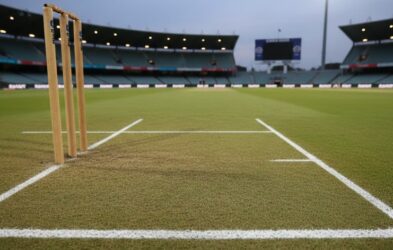
A total of eight creases are there in cricket. If this does not feel right, let me explain in more detail. Creases in the game of cricket are the white lines that are marked on the pitch. These are used to make critical decisions related to batting, bowling and fielding. The rule of eight creases in cricket is mentioned in the official Laws of Cricket maintained by the Marylebone Cricket Club (MCC). Moreover, this rule is enforced by the International Cricket Council (ICC) as well.
Each end of the pitch has four creases, making it a total of eight creases in cricket. Each end has one bowling crease, one popping crease and two return creases. Creases in cricket are usually marked in white. These are around 5 inches wide and are clearly visible. Let us understand these creases in cricket in more detail.
Bowling crease – This is essentially the end point of the pitch, serving as a reference point for the bowler. The bowling crease is a straight white line that passes through the three stumps at both ends. The measurement of the bowling crease in cricket is around 2.64 meters in length. The rear end of this line serves as the boundary for the bowler’s delivery stride.
From end to end, the two bowling creases measure the exact length of the pitch. This is 20.12 meters between the two bowling creases. To avoid a No-ball situation, the bowler’s back foot must land within the area bounded by the return creases. The bowling creases in cricket are also used to define other creases. Without these, the rules of the game of cricket will become difficult to implement.
Popping crease (Also known as batting crease) – Most cricket fans are aware of this, as this is widely noted during run-outs and stumpings. Awareness about the popping crease has been especially more since umpire decisions became dependent on slow motion videos, handled by the third umpire. Technically speaking, the popping crease or the batting crease in cricket runs parallel to the bowling crease at both ends of the pitch.
The distance between the popping crease and bowling crease is 1.22 meters. Width is 1.83 meters from the center. However, for situations like runouts and stumpings, the width is essentially limitless. Several decisions are taken by the third umpire by using specialized software that can decide accurately in cases where the batsman could be away from the white popping line. The popping line is also used to declare a no-ball.
Return creases – There are two return creases at each end of the pitch. These are drawn perpendicular to the popping crease and running backward from it. Extending from the ends of the bowling creases, the return creases determine the bowler’s delivery area. The return creases in cricket are placed 1.32 meters on either side of the imaginary centerline that connects the middle stumps at both ends. The drawn lines extend 2.44 meters behind the popping crease and are considered to be of unlimited length.
To avoid a no-ball, the bowler’s back foot should land between the two return creases. These are also used by the umpires to declare a wide ball. The return creases are also used to determine if the bowler is running on the protected area of the pitch. If found doing so, umpires can issue warnings or impose penalties on the team.
Hope the information above has helped you understand how many creases there are in cricket. There can be variations, but in most international level matches, the above rules about creases are applicable. Creases in cricket play an important role and efforts are made for their proper marking and maintenance.