 Newspatrolling.com News cum Content Syndication Portal Online
Oceans are vast and even with the limited information we have about them, confusions still prevail across various aspects
Although we like visiting beaches and islands, most of us are not well informed about the vast oceans and their innumerable creatures. These living beings are entirely different from the largely mammalian species found on land. Things become even more confusing due to the naming convention used over the years to describe the various sea creatures. A relevant example is the difficulty in establishing the correct identity of starfish and jellyfish. Here’s the real truth of what these creatures actually are.
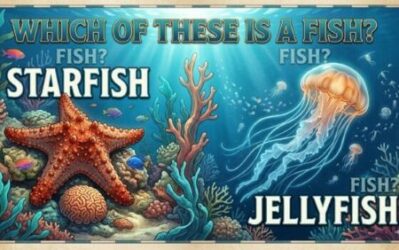
Which of these is a fish: Starfish or Jellyfish?
To understand which is a fish among starfish and jellyfish, we first need to understand the logic for classifying a creature as a fish. True fish species are the ones that are classified as aquatic vertebrates. These belong to the phylum Chordata (specifically subphylum Vertebrata). To qualify for a fish, the creature needs to have some specific features.
For example, it should have a backbone (vertebral column), gills for breathing, fins for movement, scales, a closed circulatory system with a heart and bilateral symmetry. Fish can be part of groups like jawless fish (like lampreys), cartilaginous fish (like sharks, rays) and bony fish (like common fish types salmon, tuna, etc.).
Now coming to whether the starfish or jellyfish is a fish, let’s first look at the starfish. Although both starfish and jellyfish have a ‘fish’ suffix, it does not mean that they are actually a fish species. In reality, starfish is classified as Phylum Echinodermata. This category has other creatures like sea urchins, sand dollars, and sea cucumbers. This is Class Asteroidea.
Starfish is not a fish since it does not have a backbone, gills or scales. The correct classification for starfish is invertebrates. Key features of starfish include radial symmetry, water vascular system and regeneration ability. Starfish are usually predators or scavengers, often eating mollusks like clams by everting their stomach. Starfish can be found on the seabed, across both shallow and deep waters.
Interestingly, modern day biologists have stopped using the name ‘starfish’. Instead, they call these creatures ‘sea star’. This helps avoid the wrong connection to the fish species. Coming to jellyfish, this is also not a fish. Most species of jellyfish actually belong to class Scyphozoa. These are classified as Phylum Cnidaria, the same category as used for corals, sea anemones, and hydroids.
Jellyfish is not a fish because it does not have a backbone, true brain, gills, fins or scales. Jellyfish also belongs to the broader invertebrates category. Jellyfish has a gelatinous, umbrella shaped body with trailing tentacles. It has radial symmetry and stinging cells called Cnidocytes for capturing prey. Instead of a centralized brain, the jellyfish has a simple nervous system.
Life cycle often includes a polyp stage (sessile) and medusa stage (free-swimming, the “jellyfish” form). Jellyfish tend to drift with ocean currents. Some of these are known to be venomous. Interestingly, not all umbrella shaped creatures are jellyfish. Some of these belong to a different phylum (Ctenophora) category.
Why the confusion?
The ‘fish’ suffix is probably the main reason why many people think that starfish and jellyfish are fish. Also, because both these creatures are found in the seas and oceans of the world. Even across aquariums, these creatures are often kept along with other sea life including real fish species. All these factors make people believe that starfish and jellyfish are fish. In reality, neither starfish nor jellyfish is a fish.