 Newspatrolling.com News cum Content Syndication Portal Online
 You’ve probably heard that the only way to run profitable crypto trading bots is to park your capital on the highest-volume exchange you can find. The logic sounds airtight: more liquidity means tighter spreads, which means better fills for your automated strategies. But that reasoning oversimplifies how bots actually generate — or bleed — returns. After spending time configuring grid and DCA strategies across multiple platforms, I’ve found that fee compounding, parameter flexibility, and strategy accessibility routinely outweigh raw order-book depth.
What follows challenges four assumptions most traders carry into algorithmic crypto trading, and looks at where the conventional wisdom falls apart.
“Bigger Exchange, Better Bot Results” — Why Volume Alone Misleads
The default assumption is that exchange volume is the single variable determining bot performance. Deeper order books reduce slippage, so every grid fill or DCA buy executes closer to the mid-price — that’s the theory. But for the strategies retail users actually deploy — automated trades on mid-cap altcoin pairs, not institutional arbitrage on BTC/USDT — reality is messier than that.
According to on-chain research aggregated by Messari, liquidity fragmentation across exchanges means a mid-tier venue can offer comparable effective spreads on long-tail pairs, especially when it lists a broader selection of those pairs to begin with.
| Factor | Relative Impact on Grid/DCA Bot P&L |
| Raw exchange volume (top-3 pairs) | Moderate — mostly matters for large orders |
| Trading fee per fill | High — compounds across hundreds of micro-trades |
| Grid resolution (min/max subdivisions) | High — determines how finely the bot captures range |
| Strategy variety (DCA, grid, martingale) | Medium-High — wrong strategy for the regime nullifies any spread advantage |
Volume matters. It’s just one input among several. Traders who fixate on it often ignore the variables that actually erode automated returns.
Fee Drag Is the Silent Bot Killer
Here’s a number that looks harmless: 0.1% per trade. Now multiply it by 200 grid fills in a single month — a realistic count for an active spot grid bot — and the cumulative drag starts to sting. A 0.01% fee difference between two exchanges, compounded across hundreds of round-trip trades, can eat a meaningful chunk of the bot’s gross profit.
Consider a simple illustration. A platform charging 0.1% maker and 0.1% taker on spot generates 0.2% in round-trip cost per grid fill. Over 200 fills on a 1,000 allocation, that’s roughly 4 in total fees. A platform charging 0.15%/0.15% pushes that to $6 — a 50% jump in fee drag that most traders never calculate upfront. Fee structures vary widely; these numbers are illustrative. Check each platform’s current fee page before making comparisons.
For futures-based bots, the math shifts further. BYDFi, for example, currently advertises competitive perpetual futures fee tiers — users should verify the latest maker/taker rates on the BYDFi fee schedule page before deploying leveraged grid strategies, as rates may change. As The Block has reported, fee competition among derivatives venues has intensified, making it worth checking the exact taker rate before running any multi-exchange bot.
The contrarian point: Don’t pick your bot platform by brand recognition. Run the fee arithmetic first.
 “You Need Coding Skills to Run Crypto Trading Bots” — The Marketplace Counter-Example
Conventional wisdom says effective algorithmic crypto trading requires API keys, Python scripts, and a background in quantitative finance. That was arguably true in 2020. It’s increasingly wrong in 2025–2026, as exchanges roll out no-code bot builders and curated strategy marketplaces.
Several platforms now illustrate the shift toward accessibility:
| Platform | Bot Types Available | Notable Feature | Consideration |
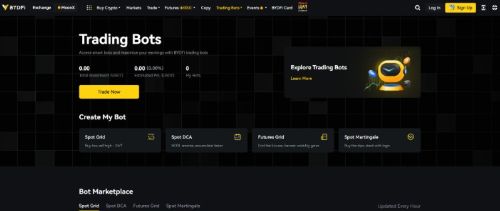
| BYDFi | Spot DCA, Spot Grid, Futures Grid, Spot Martingale | One-click deployment from a community bot marketplace; AI-recommended grid parameters | Smaller exchange by volume; marketplace is relatively new |
| Pionex | Grid, DCA, Rebalancing, Smart Trade, and others | Built-in bots with no separate subscription; 16+ free bot types | Lower altcoin selection on some pairs; limited futures bot options |
| Bitget | Spot Grid, Futures Grid, DCA, CTA strategies | Copy-trading integration lets users mirror top bot deployers | Futures-heavy platform; beginners should be careful with leverage defaults |
| 3Commas | DCA, Grid, Options, Smart Trade | Multi-exchange support via API; advanced signal-based automation | Requires connecting external exchange accounts; subscription-based pricing |
Each platform takes a different approach to lowering the technical barrier. BYDFi’s marketplace model lets users browse community-created strategies, review historical performance data, and deploy with a single click — during testing, the interface loaded noticeably fast and the whole one-click deployment took under a minute. Pionex embeds bots directly into the exchange at no extra fee. Bitget layers bot automation onto its copy-trading ecosystem. 3Commas offers the broadest multi-exchange flexibility for users willing to manage API connections and pay a subscription.
Which one fits depends on whether you’re prioritizing simplicity, cross-platform control, or a specific strategy type. There’s no universal winner here.
Spot-Only vs. Futures Bots — Risk Profiles That Don’t Belong in the Same Sentence
One distinction many comparison articles gloss over: spot grid carries no forced-liquidation risk because it operates entirely in spot markets. Futures grid involves leverage and exposes users to liquidation. Lumping them into the same “grid bot” category without flagging the difference does readers a disservice. If you’re new to crypto bot strategies, spot variants are the safer starting point — futures automation introduces a materially different risk profile. Not optional reading. Essential.
“A Demo Account Won’t Teach You Anything Real”
Dismissing paper trading is fashionable in trading communities. The argument: without real money on the line, you don’t learn emotional discipline. Partially true — but it misses the point of demo-testing bots specifically. Bots don’t have emotions. What demo environments actually reveal is parameter sensitivity: how grid width, DCA interval, or martingale scaling factor respond to different price action.
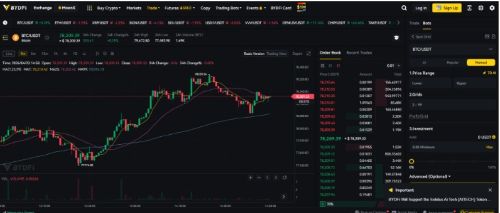
BYDFi provides a demo account with simulated funds, letting users test bot strategies in a sandbox before committing capital. Worth noting that demo conditions won’t fully replicate live-market slippage and liquidity. A practical approach: run one spot grid and one spot DCA bot in parallel for seven days, compare fill counts and simulated PnL, then decide which strategy matches your target pairs. Resources like Investopedia’s guide to futures and backtesting concepts offer useful background on why simulation matters before going live.
What This Comparison Actually Tells You — And What It Can’t
No comparison article — this one included — can predict bot profitability. Market regime, pair selection, and individual risk tolerance dominate outcomes far more than any platform feature. What the analysis can do is reframe how you evaluate crypto trading bots across exchanges:
- Fee math over volume hype. Calculate round-trip cost across your expected fill count before choosing a venue.
- No-code access over technical gatekeeping. If a platform requires custom scripts to run basic strategies, the barrier isn’t protecting you — it’s slowing you down.
- Demo rigor over blind deployment. Test parameter sensitivity in a sandbox. Bots are mechanical; the learning happens in configuration, not emotional trial-by-fire.
Among the platforms examined here, BYDFi trading bots — spanning a marketplace model, four strategy types, and a broad selection of spot pairs (the platform lists over 1,000 at the time of writing) — are one option worth evaluating for traders who prioritize accessibility and fee transparency. Pionex appeals to users who want built-in bots with zero subscription cost, Bitget suits those already embedded in copy-trading workflows, and 3Commas remains a strong choice for multi-exchange power users. Each has trade-offs in pair coverage, fee structure, and strategy depth — and none of them are perfect. Scaling exposure gradually and verifying results independently remains the prudent path, regardless of which exchange you pick.